Design, planning & reporting
Design and planning of animal experiments
Systematic literature search
For studies including animal experiments a literature analysis is essential to prove that no alternatives to the use of animals are available, the adequate animal model / methods are used and the 3R principles are implemented. The Literature Search Guide (PDF, 280 KB) summarizes important steps of such a search.
See also ETPLAS Course on literature search.
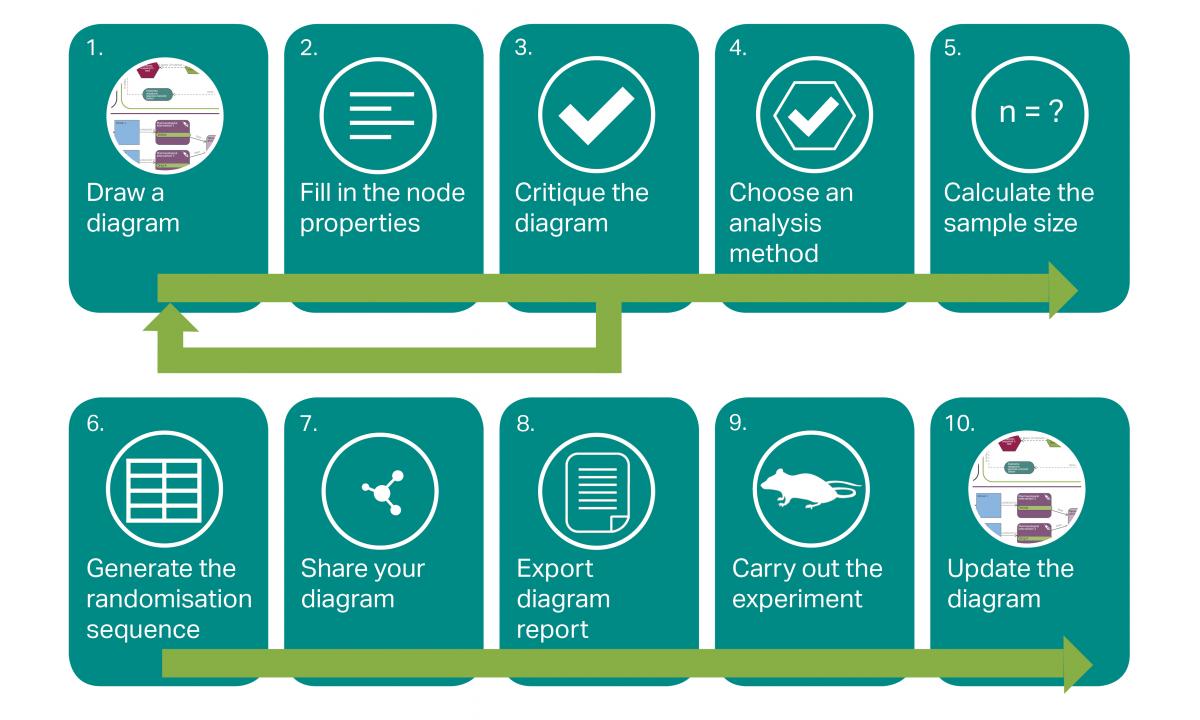
Experimental Design Assistant
See also the interactive course on reduction and experiment design and further information on experimental design.
PREPARE guidelines
Planning Research and Experimental Procedures on Animals: Recommendations for Excellence
PREPARE focuses on a large number of factors which can influence the validity and outcome of animal experiments as well as the health and safety of all concerned. They cover all levels of quality assurance, from the management of an animal husbandry and breeding operation to the individual procedures that are part of a study. The guidelines and the checklist are based on the authors' experience with the operation of animal experimental facilities, collaboration with researchers (including those working with farm animals, fish and wildlife), participation in advisory and regulatory committees and the planning of own animal experiments. PREPARE complements the guidelines for reporting on experiments such as the ARRIVE guidelines
Pre-registration of animal experiments
Online register for scientific studies with animals:
The Interspecies Database
The Interspecies Database provides insight into physiological, anatomical and biochemical parameters of various animal species and humans. It helps researchers to select the best model for a study. This could lead to a reduction in animal numbers.
Cancer-SOLES
Cancer-SOLES uses a series of automated tools and machine-learning approaches to systematically collect, synthesise, and display experimental evidence in animal models testing targeted therapies against cancer.
Cancer-SOLES uses a series of automated tools and machine-learning approaches to systematically collect, synthesise, and display experimental evidence in animal models testing targeted therapies against cancer
Reporting Guidelines
ARRIVE guidelines
Animal Research: Reporting In Vivo Experiments
The ARRIVE guidelines are designed to improve the reporting of research involving animals - to maximize published information and minimize unnecessary studies. The guidelines were developed in consultation with the scientific community as part of an NC3Rs initiative.
FAIR Principles
In 2016, the FAIR Guiding Principles for scientific data management and stewardship were published in Scientific Data. The authors intended to provide guidelines to improve the Findability, Accessibility, Interoperability, and Reuse of digital assets. The principles emphasize machine-actionability (i.e., the capacity of computational systems to find, access, interoperate, and reuse data with none or minimal human intervention) because humans increasingly rely on computational support to deal with data as a result of the increase in volume, complexity, and creation speed of data.